George Washington: God’s Indispensable Man

Updated: Jul 4
Surely the wrath of man shall praise thee: the remainder of wrath shalt thou restrain. Psalm 76:10

This coming Saturday, July 4, 2026, is our nation’s 250th celebration of the English colonies declaring independence from Great Britain and an end to monarchial rule. In keeping with the spirit of the day, I decided to relate a story once common knowledge among a grateful and patriotic citizenry. I had originally posted this little narrative on Independence Day a few years back when the country was reeling from social chaos brought about by political opportunists, seeking to capitalize on the latest human tragedy.
Subsequent to the national theatrics of widespread protests, more institutional effort was made to divorce the American people from our founding and the men and women who lived through those times and birthed a nation unlike any other in history before or since. An unnatural phenomenon that has arisen in recent years is what I call the toxification of history. Its real and its dangerous, so evidenced by the cultural suicide being embraced by certain States of the European Union as well as the UK whose foreign and domestic policies over the last two decades are literally destroying their countries from within. A less militant, yet equally serious effect, of this "toxification" is the ill favor and low interest it intentionally cultivates in the young people of Western culture leaving them adrift in a sea full of ideological sharks waiting to claim their next victim.
Here in America, it has become fashionable to malign great men who were once our heroes. Usually this is based on a charge of racism. However, race-based indictments are only a tool, a weapon, the battering ram with which the walled city is to be breached by a persistent and dark ideology built on the grievance, real or imagined, of the "have nots" vs. the "haves", the latest iteration of the tired and worn-out struggle of the bourgeoisie against the proletariat. Once the attackers are in, "racial equity" will mean nothing because liberation is not the mission, burning down the city is. To do such a thing, those that guard the gate must be persuaded to let the invader in, or at the very least, be convinced the gate is not worthy to be guarded. This is why our founders are demonized and their intellectual arguments disenfranchised from our common dialog. John Winthrop's "city on a hill" must be brought low. The great Puritan's sermon, given on March 21, 1630, to a group about to set sail for the Massachusetts Bay Colony, was referencing scripture as related in Matthew 5:14, "Ye are the light of the world. A city that is set on an hill cannot be hid." For men like Winthrop, the English colony represented an opportunity where a righteous man could devoutly worship God, enjoying all the blessings and benefits resulting, and hold forth this example as an earthly grace of the gospel as Christians showed the reality of their faith by God's faithfulness to them, echoing James 2:18, "Yea, a man may say, Thou hast faith, and I have works: shew me thy faith without thy works, and I will shew thee my faith by my works." America was never perfect as men are fallen creatures, but she was the only nation ever founded upon liberty of the soul. Evil and seditious men hate this, they always have, they always will, echoing yet another Biblical truth, "And this is the condemnation, that light is come into the world, and men loved darkness rather than light, because their deeds were evil." - John 3:19. Easily confirmed in the physical realm, light dispels darkness, so to those who are ideological enemies of Benjamin Franklin's "efficacious experiment", the light of our founding and the founders themselves must be put out. This is not hyperbole, this is real and these forces are on the march doing great damage as they advance.
A better time, a sweeter spirit.

There was a time when American school children of all ages knew their country's origins. They knew her trials and tribulations; they knew her heroes and villains. They also knew the stories of Divine Providence that had shown great favor upon certain of her citizens in a time of national trial or the seemingly prophetic events that surrounded some of her favorite sons orchestrated by an omnipotent, omniscient, and omnipresent God showing his favor in her time of need. This is not "Christian nationalism", this is a nation that was founded by and large of Christians. Its history reflects their understanding of the world around them as they judged life from a Biblical worldview. From that perspective our stories, our legends, our tales of who we are, held forth great events from our past as histories to be preserved and passed down to the next generation.
Just such a story is that of a youthful Virginia officer George Washington and his miraculous preservation in harm's way at the Battle of the Monongahela on July 9, 1755. This coming weekend, July 4, 2026, Angel Studios is releasing a major motion picture, Young Washington. I don't have much faith when it comes to accurate portrayals of historical events on the big screen. Nevertheless, a major effort will be underway this weekend to, once again, tell the tale once known so well by a grateful republic that has in these later years, been almost forgotten. No doubt, if the screenplay is faithful to the original story, critics will have their knives out. Also, as I don't expect the movie will have the latitude in the prescribed timeslot to tell the backstory or supporting evidence, I do so here in this short narrative. Read my post, go see the movie over the weekend, and enjoy that fact that you live in a country that has actual heroes, that actually lived, and left us a legacy that we need to secure, protect, and hand down to the next generation of Americans. Now, to the story of "Young Washington".
A world on fire.
Although part of the historic tapestry of America, the event related here occurred nearly thirty

years before the Treaty of Paris was signed in 1783 that officially ended our War of Independence and granted sovereignty to all thirteen individual colonies that would become the United States of America.
In the wars of empire that raged on the world stage in the 18th century, none were greater than the Seven Years War. The conflict officially lasted from 1756 to 1763. The struggle was truly a world war involving Great Britain, France, Spain, Prussia, Austria, Russia, and a host of others from the Carnatic Sultanate in India to the Filipino rebel state of Free Ilicos. Although much blood was spilled on European battlefields and exotic outposts around the world, what became the Seven Years War actually started two years earlier in the Ohio River Valley deep in the American wilderness all set in motion by a 22-year-old young Virginia Lieutenant Colonel named George Washington.
In the years leading up to the incident, ever expanding colonies of both the French and the English into the interior of the continent brought increasing contact between trappers, fur traders, and Indian agents of the rival powers. Intermittent woodland skirmishing was constant and the employment of native rivals created a permanent atmosphere of uneasiness even in times of peace. To secure the area, both sides saw the strategic necessity of building a fort in the region near the confluence of the Allegany and the Monongahela Rivers where the Ohio River is formed. Against this backdrop a small force of Virginia Provincial troops under a young George Washington was sent into the Ohio Country by Royal Governor Dinwiddie to deliver a notice of expulsion to the French force now in that country. While under construction, Fort Prince George had been seized by the French from a small English garrison in April of 1754, the work was completed, then renamed Fort Duquesne. During Washington’s mission to deliver notice to the French, both sides clashed at a place near Great Meadows where the French commander, Ensign Joseph Coulon de Jumonville, after surrendering, was brutally killed by Seneca Chief Half King, a tragedy Washington was powerless to stop.
Washington’s mission did not go as planned and, through deception of a translator, it sparked an international incident that flamed into the largest war yet in the 18th century on a global scale. This story in and of itself is fascinating and deserves to be retold. I recommend it as essential to understanding the developing character of the colonial mind in pre-revolutionary America. However, it is not this event but what happened afterward that is the focus of this particular post.
After Washington’s failed expedition, Great Britain declared war on France in May of 1754. In response to French encroachment into what England viewed as their territory, a military expedition was undertaken in such force as to completely reduce or capture the single military symbol of French defiance in the region, Fort Duquesne located at the site of modern-day Pittsburg, Pennsylvania.
Upon the urging of Virginal Royal Governor Dinwiddie, the Crown sent two regiments, the 44th and the 48th Regiment of Foot, under the command of Edward Braddock to America to assist in opposing this new threat to the backcountry. Braddock was appointed to command of all British forces in America, regulars as well as provincials. Owing to the complexity of war in America due to its sheer size and untamed wilderness regions, a grand strategy was developed which was intended to overwhelm the French simultaneously in multiple locations before any reinforcements could be made to any single beleaguered area. Braddocks overland campaign would be the largest undertaken with two smaller efforts made against Niagara, Crown Point, and a naval operation against Nova Scotia.
The Shattering of Souls...

A British column of 2,200 men under Commander-in-Chief Major General Edward Braddock set out for the Ohio Country on May 29th. For the next five weeks the column struggled within a near primeval forest having to stop constantly as engineers felled trees and widened the road in an attempt to allow the long winding military column to retain some cohesion as it meandered through the wilderness. As a soldier of the Virginia Provincials with a direct appointment from the Royal Governor, young Washington acted as an Aide-de-Camp to Braddock. Fulfilling that role, Washington remained at Braddock’s side as the latter split the force in two and created a flying column in order to speed up the movement to Fort Duquesne before the French, who undoubtedly knew by now of their approach, could gain reinforcements. Braddock took some 1,300 men with him and left nearly 1,000 behind bringing up the wagons, artillery, provisions, and ammunition.
On July 9, less than 10 miles from the French fort, the men of the column heard the sudden crash of musketry to their front. The peacefulness of the forest had been broken by the British advance guard under Lieutenant Colonel Thomas Gage. On this day Gage commanded the 44th Regiment of Foot. It would be exactly twenty years later that Gage would once again be engaged on a colonial battlefield, this time as Commander-in-Chief of All British Forces in North America. It was his men that would fight Massachusetts militia at the battles of Lexington and Concord, Bunker Hill, and eventually abandon Boston to the rebels under a more seasoned George Washington. But for this hour, his men were firing at a shadowy enemy that appeared before them then just as quickly receded back into the forest as the Englishmen unleashed their volley. That enemy was a mixed force of French marines and allied native warriors detached from the fort to slow the English advance, roughly 800 in total. The opening fire had killed their leader Captain Daniel Beaujeu after which some 100 French fled back to the fort. However, the bulk of the force remained. These were Ottawa, Ojibwa, and Potawatomi warriors allied to the French and led by an unusual “elite” French warrior class known as Coureur de bois or “runner of the woods”. In actuality they were fur trappers but were fearless and well acquainted with the rigors of frontier life and acted as sort of a militaristic liaison between the French military and their Indian allies. Together these men formed a warrior class unmatched in the annals of military history and spread dread and fear among their enemies throughout the American wilderness. As the smoke rose upward from the English musketry, these warriors of the woodland silently lay to ground taking special care not to reveal their position or their strength to the column of soldiers on the road before them.
When the firing died off there was total silence. The European military drill of the day was based on platoon level firing within the larger companies. Men did not fire individually. As a result, all firing stopped at the command of cease firing. No shots rang out, nothing. The normal sounds of the forest were silent. Even the birds had gone quiet. The only sound heard was the creak of a leather saddle as the officer lifted himself atop his mount to gain a better vantage point, or the clank of a bayonet against a canteen as a soldier nervously pulled the vessel to his mouth while scanning back and forth with his eyes. Then was heard the shouts and orders, “By Column to the Front! Quick, March!” Upon command bodies of troops came rapidly forward to reinforce the soldiers of the advance guard that had fired the opening volley. As they negotiated the tangle of the main column suddenly the British initiative was stopped.
All at once the trees came alive with the crash of hundreds of muskets in a ring of fire that formed a near complete circle of the front of the British column. Several men in Gage’s command sank to the forest floor as French and Indian lead balls found their mark. The initial shock of the fire was so great as to immediately break the forward companies and send them hastily backward toward the protection of the main column. As they retreated away from the firing, Gage’s men ran headlong into the companies coming forward to reinforce them. Both groups collided in a tangled mass of scarlet coats which made easy targets for their antagonists. As more troops came forward, the woods were now choked thick with the sulfur laden heavy smoke produced by the firing of black powder. Again, the French and Indians poured fire into the mass. Unable to see their enemy, the newly arrived British companies halted, presented their muskets, and unleashed volleys straight into the backs of the first troops sent forward. Perceiving and mistaking that fire as the enemy, Gages men returned fire at their own reinforcements. Those in the middle fell like withered wheat before a scythe. Sensing an early victory, the Ottawa, Ojibwa, and Potawatomi warriors begin screaming and howling as they rushed forward to dispatch the wounded Englishmen with the tomahawk and lift their scalps with the knife. An unfortunate feature of such violence was often the victim would initially survive, adding their screams to the howls of their attackers, at times even briefly escaping their hand. To see a fellow soldier running toward you with his bloody skull exposed crying to be delivered from his closely pursuing attacker had no small effect on the mind of the combatants often shattering their resolve to stand and fight. Woodland warfare was intensely psychological and those that practiced it knew how to capitalize on it. Indian warriors often painted their bodies with red ochre, hence the descriptive term "Redskin", while painting their faces black with paint made of charcoal and bear grease which gave them a particularly hellish appearance as they rushed out of the darkness to slash their enemies. Many colonials referred to them as demons which, under the circumstances, to any intellectually honest observer would be understandable.
Kill that Man!

What was intended to be a brief slowing action by the French had turned into a pitched battle. For three hours the British column sought to somehow defend themselves in their exposed position. General Braddock had several horses shot from under him. What few artillery pieces the British could bring into action had little effect as the road was filled with battle formations and their line of sight was limited. Throughout the battle Washington was mounted on a horse shadowing Braddock running orders to line officers as they struggled to maintain their commands in the face of constant and devastating fire. The only command Washington had authority over was the Virginian Provincials who he placed off the road in a defensive position within the trees. These men stood their ground and kept their attackers at bay killing them indiscriminately as they rushed their position. While directing his command and relaying orders from Braddock to the line officers, Washington’s seeming omnipresence on the battlefield caught the eye of the enemy. Washington was an expert equestrian and noting the fearless energy of the horseman as he galloped in and out of danger, circling commands, up and down the length of the road, the French commanders took note and ordered him to be shot down. Washington had already had two horses shot from under him. He was also easily distinguishable due to the fact that, in addition to his conspicuous commanding presence, he was most likely wearing the regimental coat of the Virginia Provincials of indigo blue with scarlet facings as he held a military appointment only and not a royal commission. No other mounted officer wore such a uniform. Quickly word spread among the French Coureur de bois as they relayed the order, “Abattez-le!” to the numerous native war chiefs surrounding the British column; the war chiefs in turn echoing in Iroquois to their warriors the French command to “Bring him down!” The young 23-year-old George Washington had now, unknown to him, become the primary target of literally hundreds of native warriors and their French allies. Muskets and rifles erupted from near complete encirclement as Washington maintained himself in the saddle of his third horse since the action began. As he galloped by on a series of desperate attempts to rally groups of faltering soldiers, single shots from skilled riflemen, platoon volleys from French Marines, wild firing from hundreds of less accurate but still deadly trade muskets carried by so many of the native warriors, nothing pierced the body of Washington. His presence on the field seemed to morph into that of an immortal being which did not go unnoticed to those trying to shoot him down.
In addition to the two horses killed under Washington, he also had several musket balls fired through his coat tearing holes that defy physics and deny reason as to how a .62 to .69 caliber ball weighing as much as 1.14 ounces can perforate a heavy wool coat, while being worn, and not strike the wearer. While the marksmanship of an average Indian warrior with an inferior “trade musket” is questionable, the close proximity of the battle lines makes Washington’s survival impressive and hard to understand. What is not questionable is the marksmanship of the average Coureur de bois. Armed with a long rifle or the elegant French Charleville musket and a lifetime of hunting experience, makes Washington’s survival miraculous and only explainable as owing to the protecting hand of Providence.
As General Braddock, mounted atop yet another horse, paced back and forth among his men to steady their nerves, a loud thud signaled a musket ball had found its mark and punctured a lung. Stunned by the impact the General reeled in his saddle as the reigns slipped from his fingers and he toppled off his horse and hit the ground mortally wounded. Although holding no official authority, Washington seized the moment and began organizing a rear-guard action and started conducting a fairly organized retreat although no official order had been given. Washington’s actions and his ad hoc assumption of command saved the force from what could have been complete annihilation. By sunset the column, thanks to the rear guard, had been able to disengage. As they moved back down the road away from the fighting, they could see bodies of their comrades literally in piles. A morbid benefit of the casualties that lay where they had fallen was the fact of the allure these unfortunate souls held for the Indian victors as they chose to pillage, loot, and scalp the dead and dying rather than continue the fight. Also, two hundred gallons of rum captured their imagination and with that the French Coureur de bois had no hope of getting their jubilant allies to pursue the British. The battle of the Monongahela was over.

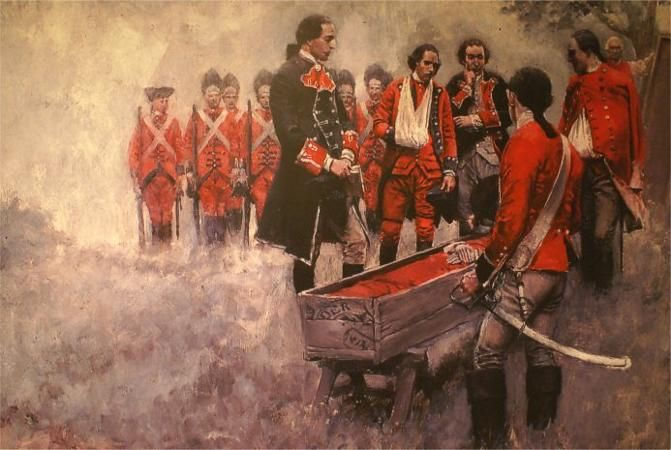
The battle had been a complete disaster for the British. Out of the roughly 1,300 men in the flying column under Braddock, nearly 1,000 were casualties with a fairly equal division between killed and wounded. Officers were hit especially hard being a favorite target of woodland warfare. With a total of 86 commissioned officers in the column, 26 were killed outright and 37 wounded. Also accompanying the column were about 50 women of whom only 4 made it back with the army. Of all the wounded, a sad reality of 18th century warfare whether in Europe or America, is that many would never recover from their wounds. General Braddock died of his wounds four days later on July 13. He was secretly buried in the middle of the road at Washington’s order to prevent the body being dug up and desecrated. The French and Indian force lost less than 50 men.
Myth or History?
In our day it seems some self-loathing Americans exert more energy to discredit or deny our past than patriotic Americans ever did to promote it. Sometimes this is done secretly, sometimes openly. Unfortunately, casualties are still falling from the battle 271 years later as the enemy now aims its weapon at truth about our history and those who lived it. While this is nothing new, the prolific spread of misinformation and disinformation via social media can impact a much wider area in far less time than in the age of analog communications and the written word.
For most of this country’s history the story of the seemingly Divine miraculous events surrounding Washington at the Battle of the Monongahela was taught in American classrooms. Now it’s doubtful if it could get a serious hearing in a church. Cynics and “haters” will tell you it’s myth, that it never really happened. That it is just a romanticized tale invented by hollow people that needed to "sanctify" American culture to hide all the bad collectively done by the United States since our founding. That the larger-than-life account of Washington that day simply didn't happen. Well, did it? Are the events of July 9, 1755, real history or are they just nationalistic myth?
According to the Encyclopedia of Virginia, Washington did write about the account. They state on their webpage,
Life of George Washington: The Soldier
"We have been most scandalously beaten by a trifling body of men...
I have been protected beyond all human probability or expectation, for I had four bullets [shot] through my coat and two horses shot under me, yet, I escaped unhurt, although death was levelling my companions on every side of me."
This is the sanitized account permitted by the new age of gate keepers of American history. What speaks volumes is the fact that the powers that be at the Encyclopedia of Virginia, an organization who shares a solemn charge to be a sentinel over Virginia’s history, intentionally misrepresented by omission the text of an actual letter written by arguably the most important man in United States history, in my opinion, to obviate any affiliation Washington had with Christianity.
George Washington’s letter to his younger brother John Augustine Washington dated July 18, 1755, as actually written states the following:
“As I have heard, since my arrival at this place, a circumstantial account of my death and dying speech, I take this early opportunity of contradicting the first, and of assuring you, that I have not as yet composed the latter. But by the All-Powerful Dispensations of Providence, I have been protected beyond all human probability or expectation; for I had four bullets [shot] through my coat, and two horses shot under me, yet escaped unhurt, although death was leveling my companions on every side of me!”
As the much beloved and greatly missed talk show host Phil Valentine used to say, “It’s not what they’re telling you. It’s what they’re not telling you that reflects the bias of the media.”
Regarding the account of the holes being shot through the coat, Washington repeats the claim to his mother Mary Ball Washington:
“The Genl was wounded; of wch he died 3 Days after; Sir Peter Halket was killd in the Field: where died many other brave Officer’s; I luckily escapd witht a wound, tho’ I had four Bullets [shot] through my Coat, and two Horses shot under me;”
What does the historical record say?

There is another intriguing story that originates fifteen years after the battle known as the “Indian Prophecy”. One of Washington’s closest friends was his personal physician Dr. James Craik who accompanied Washington on an expedition along the Ohio and Kanawha Rivers in the Fall of 1770. Years after the event, Dr. Craik testified repeatedly to the veracity of the story. Craik stated that while on the trip Washington was approached by an old Indian chief that claimed to remember Washington from the battle all those years ago. The old chief claimed that Washington could not be harmed in battle and that no bullet could kill him as the Great Spirit had protected him. Years later in 1827 Washington’s adopted son George Washington Parke Custis wrote a play called ‘The Indian Prophecy’ in which he elaborated on the story as follows:
At dinner time, a sachem recalled in great detail to Washington what transpired from his point of view on the day of Braddock’s Defeat fifteen years earlier. The records do not state the sachem's nation, but he may have been Shawnee, Mingo, or Delaware. Since the sachem and his fellow warriors were allied with the French, they had intended to kill Washington, who took over command of the British army’s attempt to retreat after Braddock was injured. Multiple shots were fired directly at Washington, but none touched him. Washington recalled to his mother Mary Ball Washington a few days after the battle that “I luckily escap'd with't a wound, tho' I had four Bullets through my Coat, and two Horses shot under me.” Convinced that the Great Spirit had preserved Washington, the chief prophesized that “he will become the chief of nations, and a people yet unborn, will hail him as the father of a mighty empire!”
A fantastic story, yes, but hard to believe doesn’t mean it’s not true. Washington was a quiet man of dignity. By the time he was in his mid-teens he had written ‘110 Rules of Civility’ a guide he would use throughout his life. In short, what we know of Washington’s very public character, he strikes me not as a man who would have regaled the public with stories of him be Divinely chosen to escape injury in battle or be the father of a country. To do so, to a man like Washington, would be an overt display of vanity, something totally inconsistent with his character as we know it. Yet there is a hint by his own hand that just such a meeting did occur. An interesting entry dated the 19th of October in his 1770 Journal reads as follows:
19th. - Received a message from Colonel Croghan, that the White Mingo and other chiefs of the Six Nations had something to say to me, and desiring that I would be at his house about eleven, where they were to meet. I went up and received a speech, with a string of wampum from the White Mingo, to the following effect.
"That as I was a person whom some of them remember to have seen, when I was sent on an embassy to the French, and most of them had heard of, they were come to bid me welcome to this country, and to desire that the people of Virginia would consider them as friends and brothers, linked together in one chain; that I would inform the governor, that it was their wish to live in peace and harmony with the white people, and that though there had been some unhappy differences between them and the people upon our frontiers, they were all made up, and they hoped forgotten; and concluded with saying, that their brothers of Virginia did not come along them and trade as the inhabitants of the other provinces did, from whence they were afraid that we did not look upon them with so friendly an eye as they could wish."
Could this be the meeting of which Dr. Craik spoke of? Could Washington be exhibiting his characteristic humility by omitting details from this entry that would have provided a historical record of the conversation in his own hand?
To me there is no doubt of Washington escaping hurt during the 1755 battle. The holes in his coat were real. The question is did the French and Indian combatants on that day make a determined effort to kill Washington and yet he survived? Did he really have hundreds of muskets trained on him without effect? Did, as one account states, the Indians become afraid as repeated attempts to down the man failed and led them to believe he was Divinely protected in the midst of battle. That version goes on to say the chiefs began halting the fire of their warriors much to the dismay of the French as they began to fear Divine retribution. The most compelling evidence that Washington’s miraculous survival at the Monongahela really happened comes from someone to my knowledge, George Washington never met.
Corroborating testimony of a serendipitous nature.

Three weeks after the battle, news spread across the frontier that a great victory had been won over the English. Emboldened by such news, Shawnee war bands out of present day Kentucky began raiding into Virginia. There they came upon an area known as Draper Valley in the area of present day Roanoke, Virginia. They attacked a settlement there and massacred Colonel James Patton, Casper Barger, Mrs. George Draper, one of the Draper children and wounded James Cull. They also captured Mary Draper Ingles, her two sons, and a Mrs. John Draper and a man named Henry Leonard. The captives were led as far away as Kentucky first and then Ohio. Along the way Mary Draper Ingles was separated from her sons. During her captivity, she overheard a meeting where some Shawnee were discussing with some Frenchmen the events that had recently transpired north along the Monongahela River. They described in detail with fascination how a chief named Red Hawk claimed to have shot at a young mounted officer eleven times but never wounded him. In her account the chief named the officer as Washington which would not be beyond the realm of possibility considering Washington had previously functioned as the ambassador to the French in that region and was well known by many of the Indian people as well. After several months of captivity Mary Draper Ingles made her escape and made an incredible journey of over 800 miles through the winter and returned home to Draper Valley. Her harrowing account of her captivity as well as the story concerning Chief Red Hawk’s claim was told by her to her son who eventually wrote her biography that was published in 1824. A second historical source for Mary’s account was written in an 1843 letter by the daughter of Colonel William Preston. Colonel Preston was a survivor of the 1755 Draper Valley massacre and presumably told his daughter the tale long after the event. A final piece of historic evidence that affirms the saga of Mary Ingles Draper is the account published in the 'New York Mercury', a New England newspaper, on February 16, 1756, in an article titled “a Traveler who lately came from New River in Virginia”. The account of Mary Draper Ingles is secure in history. She was a real person and the events she experienced were real. It’s hard to reconcile a woman with the human spirit to endure what she endured, who without a doubt had her own “grandest of tales” to recount, would feel the need to spice up the details of her own story by making reference to an event that there’s little chance she could have known about at the time of her capture. I personally don’t think what we know of her character supports someone who would spin yarns when her real-life experiences overshadow most fictions.
So, did a young George Washington display heroic courage and steadfast leadership in the face of horrific danger? Of this there can be no doubt. Did musket balls pass through his uniform without grazing his body? Yes, I believe they did and the historical record supports it. Was Washington individually singled out to be shot down by his attackers? Knowing woodland warfare and the reputation of the rather rogue like Coureur de bois, there penchant for shooting down officers, and the ferocity of the native warriors at the battle, I believe it requires more mental gymnastics to think they would not have shot at a prominent leader who was effectively directing a defense. The final question is, why then was George Washington not killed when it seems so obvious that he should have been? I personally believe he was a man for the time called forward for just such a time as that in which he lived and yes, George Washington, not predicated on his actions or personal belief, rather on God’s good will and purpose, was supernaturally kept by Him to be as safe in battle as in bed. - JLB
My times are in thy hand: deliver me from the hand
of mine enemies, and from them that persecute me.
Psalm 31:15


Comments