The Gales of November - Part 1

War on a Grand Scale

What has become known most widely as the American Civil War, began as all other wars have in the age of linear tactics, with formal confrontations, conducted on a day or two of combat, in an open set-piece battle, with the clear victor remaining in possession of the field while the vanquished moved away in retreat to friendlier ground suffering the ignominy of defeat. While the battle may have been conclusive, even decisive, for four years no end was achieved so the war raged on. After each battle, the bloodied armies would lick their wounds, refit and resupply, and go at it again on another day, in another place, in yet another bid for an overwhelming victory that would decide the outcome of the entire war.
It has been said the Civil War was fought in 10,000 places. What began in South Carolina migrated into
the other Southern states with some notable incursions into a few of the Northern states. However, in all of those places up through the end of 1863, none ever brought about total victory or total defeat. What it did bring about was Total War, the result of which devastated the South, the center of American wealth in 1860, and financially shackled the North by the creation of a flat rate income tax of 3% in 1861 which was followed quickly by an increased progressive tax in 1862, a bid to meet the national debt which by 1865 would increase from 1860 by 3,915%.
Most that study the war have been content to consider the Battle of Gettysburg fought on July 1-3, 1863, as the turning point of the war. However, even after that titanic and costly struggle, 54,000 casualties in three days, through the town and across the farms and fields of that sleepy little hamlet in south-central Pennsylvania, the South was far from defeated. This would be readily displayed in the Eastern theater as Lee skillfully and repeatedly battled Grant to a standstill in the overland campaign of 1864 and more immediately in the Western theater in September along Chickamauga Creek in northern Georgia.

At the Battle of Chickamauga, fought over three days, September 18-20, 1863, the Union army suffered its greatest defeat in the Western theater as the Army of the Cumberland under Major General William S. Rosecrans was met in an all-out assault by the Army of Tennessee under command of General Braxton Bragg. With the aid of some timely reinforcements, Bragg, in a desperate struggle, soundly defeated Rosecrans at the cost a combined total of some 37,000 casualties, second in human costs only to Gettysburg. One of the unique features of the Battle of Chickamauga was the fact that the Confederate War Department in the months immediately following Gettysburg, showed signs of ingenuity that heralded the future of military conflict that the world wouldn’t become acquainted with till World War I, the widespread use of railroads in warfare.
With a brief exception witnessed during the 1870-71 Franco-Prussian War, military railroads would not become a mainstay of strategy until the early 20th century. Although widespread usage was still 50 years away, the Confederacy, in August of ’63 began moving Major General Bushrod Johnson’s Division by rail some 800 miles from Mississippi through Mobile, Alabama, to Montgomery via Mobile & Ohio Railroad, then switching to the Western and Atlantic Railroad bound for Atlanta, and from there up to Ringgold, Georgia in an effort to reinforce Bragg. Even more audacious was the detachment of Lieutenant General James Longstreet’s Corps from the Army of Northen Virgina to reinforce Bragg in Georgia.
After conferring with President Jefferson Davis, General Robert E. Lee decided to dispatch Longstreet to Georgia in an effort to create a point where the South might amass a numerical advantage over the enemy and gain a decisive victory and hopefully regain the military initiative lost at Gettysburg. What followed was the plan for a very complex logistical movement with intricate time tables designed to move the approximate 15,000 men of John Bell Hood’s and Evander McLaws divisions over 950 miles to a completely different theater of war.

To accomplish this Longstreet’s Corps boarded a train at Orange Courthouse, Virgina on September 9. They lumbered south along the Virginia Central Railroad to Richmond where they switched trains to the Richmond & Danville Railroad. Still rolling south, they came into Danville where they transferred to the Piedmont Railroad and headed for Greensboro, North Carolina. Here they boarded the North Carolina Railroad and headed for Charlotte via Salisbury. From Charlotte, aboard the Charlotte & South Carolina Railroad, they set out for Columbia, South Carolina. Thence travelling along the South Carolina Railroad they went from Columbia to Augusta, Georgia. Switching to the Georgia Railroad they journeyed west to Atlanta. Transferring to the last of eight separate railroads, the last leg of their journey was aboard the Western & Atlantic Railroad heading north with Longstreet’s Corps finally offloading at Ringgold, Georgia just south of Chattanooga, Tennessee. The journey of 950 miles, in a span of 12 days, crossing four states, and going into battle in less than 24 hours after arrival, was an astounding accomplishment of logistical daring that resulted in the much hoped for decisive victory the Confederacy had been looking for since their defeat at Gettysburg earlier in the year.
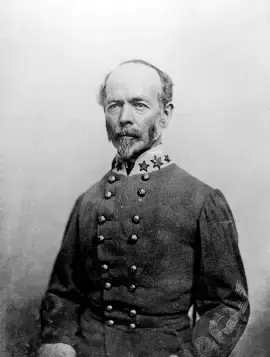
This victory would be short lived though as the Union broke out of a two-month siege at the Battle of Chattanooga on November 25 compelling the Confederate Army to pull back into Northern Georgia. General Braxton Bragg, highly unpopular with most who came in contact with him throughout his career, was blamed for squandering the South’s golden opportunity so hard won at Chickamauga back in September. Bragg, shouldering the burden of defeat, submitted his resignation to President Jefferson Davis on December 2, Davis accepted. Command of the army temporarily fell to Lieutenant General William J. Hardee with Joseph E. Johnston officially taking command on the 16th.
After the victory at Chattanooga in November of ’63, the Union army stayed in place. The previous month, after the defeat at Chickamauga, the War Department in Washington created the Military Division of the Mississippi as sentiment ran high in the ranks that the war was being mismanaged in the West. This was done on October 16, and General Grant was placed in charge. The new organization included the Army of the Tennessee, the Army of the Cumberland, and two corps from the Army of the Potomac. On March 2, Grant was promoted to Lieutenant General and given title of General-in-Chief of all Union armies. He left Chattanooga for Washington where he received his new commission from President Lincoln on the 9th and proceeded to Cincinnati where he met with Sherman eight days later at the Burnet House Hotel to plan their grand strategy for 1864. The meeting lasted from the 17th to the 20th from which afterwards Grant travelled to Culpepper, Virginia to take the field with the Army of the Potomac in preparation for the latest “On to Richmond” campaign about to be launched in Northern Virginia.
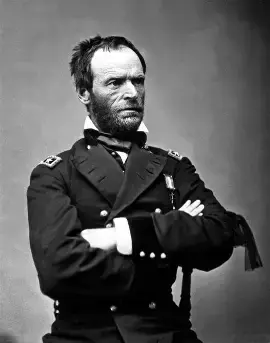
Sherman assumed command of all Union forces then in Chattanooga. Here he began to reorganize and consolidate his forces. Chattanooga was known as the “Gateway to the South” due to river access and railroads which spurred out form the city in a southward direction. Here Sherman increased his manpower and supply base in preparation for his invasion of Georgia. In early May he was joined by the Army of the Ohio under Major General John M. Schofield. Sherman, now in command of the newly reorganized Military Division of the Mississippi, had under his immediate command around 112,000 men comprising three separate armies.
Like the Confederacy had peered into the future of mechanized infantry by shifting whole corps across theaters by the use of the railroad system, so too had the Union pierced the veil and foreseen the character of wars to come by creating what would become known in the future as Army Groups, a term made familiar among waring armies of the Axis and Allied powers battling across the globe in the Second World War. When Sherman moved into the deep South in May of ’64, he did so at the head of three armies, the Army of the Cumberland, the Army of the Tennessee, and the Army of the Ohio. Johnston opposed him with the singular Army of Tennessee although within that army was the Polk’s Corps formerly of the Army of Mississippi and Hood’s Corps formerly of the Army of Northern Virginia. With the warming weather and the coming of Spring, these enormous bodies of men and munitions would inaugurate another season of killing as one side tried to defend Atlanta while the other side tried equally hard to capture her. All together some 170,000 men eyed each other across the fields in Northern Georgia in the early months of 1864 awaiting the coming campaign. Truly this was war on a grand scale. - JLB


Comments